


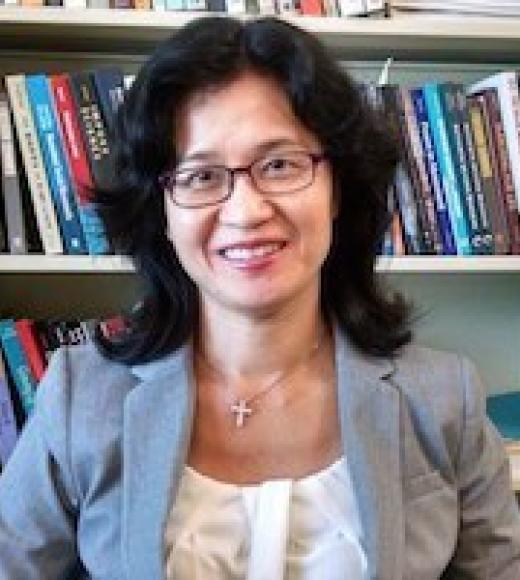
Position Title
Professor
Education
- Ph.D., Sociology, University of Michigan.
- M.A., Comparative Literature, University of Michigan.
- B.A., Department of Foreign Languages and Literature, National Taiwan University.
About
Ming-Cheng M. Lo is Professor of Sociology at the University of California, Davis. She is currently co-Editor of the British Sociological Association journal Cultural Sociology. Professor Lo’s research focuses on the cultural codes, narratives, and networks in East Asian civil societies. She has also written about the sense-making processes regarding disasters and cultural traumas. Applying similar cultural approaches to medical sociology, her research also addresses how individuals make sense of healing, illness, and suffering, and how medicine intersects with politics, ethnicity, colonialism, and neoliberalism. Lo is the author of Doctors within Borders: Profession, Ethnicity, and Modernity in Colonial Taiwan (University of California Press, 2002; Japanese edition published in 2014). She co-edited the Routledge Handbook of Cultural Sociology (Routledge, 2019; 1st edition published in 2010). Lo has published actively on culture, civil society, and health and illness in sociology and interdisciplinary journals.
Research Focus
See this 2022 interview (part 1 and part 2) for an overview of my research on colonial medicine, memories of social injustice, democratization, and COVID.
Publications
Ming‑Cheng M. Lo. 2025. “Toward a Hybrid Democratic Culture: Moral Codes in Public Narratives about COVID in Taiwan.” American Journal of Cultural Sociology.
Ming-Cheng M. Lo and Shinyi Hsieh. 2025. "Countering populism through emotive transformation: political performances during Taiwan’s 2021 COVID outbreak." American Journal of Cultural Sociology.
Ming-Cheng M. Lo, Yu-Yueh Tsai, and Michael Shiyung Liu, eds. 2024. Taiwan’s COVID-19 Experience: Governance, Governmentality, and the Global Pandemic. London: Routledge, forthcoming.
Bin Xu and Ming-Cheng M. Lo. 2022. "Towards a Cultural Sociology of Disaster: Introduction." Poetics 93A: 101682.
Ming-Cheng M. Lo and Yun Fan. 2022. "How Narratives of Disaster Impact survivors’ Emotionality: The case of Typhoon Morakot." Poetics 93A: 101579.
Ming-Cheng M. Lo and Emerald T. Nguyen. 2021. "Resisting the Racialization of Medical Deservingness: How Latinx Nurses Produce Symbolic Resources for Latinx Immigrants in Clinical Encounters." Social Science & Medicine 270: 1-9.
Ming-Cheng M. Lo. 2020. “How Taiwan’s Precautionary Approach Contained COVID-19.” Contexts 19(4): 18–21.
Ming-Cheng M. Lo and Hsin-Yi Hsiesh. 2020. "The 'Societalization' of Pandemic Unpreparedness: Lessons from Taiwan's COVID Response." American Journal of Cultural Sociology 8: 384-404.
Ming-Cheng M. Lo and Yun Fan. 2020. “Brightening the Dark Side of Linking Social Capital? Negotiating Conflicting Visions in Post-Morakot Reconstruction in Taiwan.” Theory and Society 49: 23-48.
Ming-Cheng M. Lo and Emerald Nguyen. 2018. "Caring and Carrying the Cost: Hispanic Nurses' Challenges and Strategies for Working with Co-Ethnic Patients." RSF: The Russell Sage Foundation Journal of the Social Sciences 4(1): 149-71.
Ming-Cheng M. Lo. 2015. "Conceptualizing Unrecognized Cultural Currency: Bourdieu and Everyday Resistance among the Dominated." Theory and Society 44 (2): 125-152.
Ming-Cheng M. Lo and Roxy Bahar. 2013. "Resisting the Colonization of the Lifeworld? Immigrant Patients' Experiences with Co-Ethnic Healthcare Workers." Social Science & Medicine 87: 68-76.
Ming-Cheng M. Lo and Clare Stacey. 2008. “Beyond Cultural Competency: Bourdieu, Patients and Clinical Encounters.” Sociology of Health and Illness 30 (5): 741-755.
Ming-Cheng M. Lo and Eileen M. Otis. 2003. “Guanxi Civility: Processes, Potentials, and Contingencies.” Politics and Society 31 (1): 131-162.
Teaching
Professor Lo teaches courses on field methods, society and disaster, social movements, and sociology of health and illness.
Op-Eds and Other Media Contributions
- Holding the legislature in contempt, Taipei Times, May 23, 2024.
- No unity on UN Resolution 2758, Taipei Times, September 27, 2024.
- Democracy requires deliberation, Taipei Times, December 30, 2024.
- Can Taiwan’s democracy be saved? Taipei Times, January 15, 2025.
- Taiwan facing a new world order. Taipei Times, March 5, 2025.
- Taiwan’s past and present collide. Taipei Times, May 4, 2025.
- Exploiting trauma for political gain. Taipei Times, May 10, 2025.
- The crisis the world is ignoring. Taipei Times, July 22, 2025.
- Interpretations of the recall results. Taipei Times, August 1, 2025.
- Averting an ungovernability crisis. Taipei Times, October 19, 2025.
- Countering disinformation on all axes. Taipei Times, October 25, 2025.
- Why embrace cynicism over hope? Taipei Times, November 11, 2025.
- Uninformed, high emotion voters. Taipei Times, December 21, 2025.
- China’s mind games test Taiwan. Taipei Times, April 26, 2026.
- The ‘peaceful reunification’ trap. Taipei Times, August 5, 2026.
- The NHI waiver raises concerns. Taipei Times, Octorbor 20, 2026.
Awards
2025-2027 L&S Unites Grant, UC Davis (Co-PI).
2023-2024 Scholar Grant, Chiang Ching-kuo Foundation for International Scholarly Exchange.
2022-2024 Seed Grant for Global Activities, UC Davis.
2022 Faculty Research Fellowship, Davis Humanities Institute.
2013-2016 Initiative Grant, Pacific Rim Research Program.
2010-2013 Scholar Grant, Chiang Ching-kuo Foundation for International Scholarly Exchange.
2006-2008 Researcher Grant, Robert Wood Johnson Foundation.
2001-2002 The Davis Humanities Institute Fellow, UC Davis.
1999 APRU Fellow, Association of Pacific Rim Universities.
1995-96 Sawyer Research Fellow, The International Institute at University of Michigan.
1995 Certificate of Recognition, Sigma Xi The Scientific Research Society, University of Michigan Chapter.